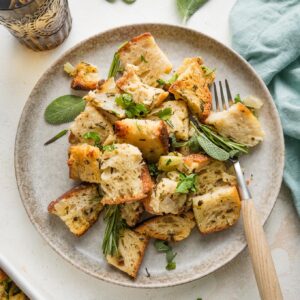
Classic Buttery Bread Stuffing
Everything you crave in a holiday side: seasoned hunks of bread, tender onions and celery, and a full array of fresh herbs to evoke everything you love about fall and winter.
Ingredients
- 15 cups dried bread cubes from one large or two medium loaves of bread, a little more or less is fine
- 1/2 cup plus 3 Tablespoons butter divided
- 1 large yellow or sweet onion peeled and chopped
- 4-5 ribs celery
- kosher salt and black pepper
- 4-5 cloves garlic minced
- 2 Tablespoons chopped fresh parsley
- 2 Tablespoons chopped fresh sage
- 2 Tablespoons chopped fresh thyme
- 2 Tablespoons chopped fresh rosemary
- 2 large eggs
- 2 and 1/4 cups low-sodium chicken or vegetable broth
- extra fresh herbs for sprinkling
Instructions
- Dry out the bread cubes if necessary, then place them all in a very large bowl.15 cups dried bread cubes
- Preheat the oven to 375°F. Lightly coat a 9x13-inch baking dish with cooking spray; set aside.
- Melt the ½ cup butter in a large skillet over medium-high heat, then stir in the onion and celery. Add ¾ teaspoon each of kosher salt and black pepper, or more to taste. Cook for 5-8 minutes, until softened.1/2 cup plus 3 Tablespoons butter, 1 large yellow or sweet onion, 4-5 ribs celery, kosher salt and black pepper
- Add garlic, parsley, sage, thyme, and rosemary to the skillet. Cook for 1-2 minutes more, until very fragrant, then remove from the heat.4-5 cloves garlic, 2 Tablespoons chopped fresh parsley, 2 Tablespoons chopped fresh sage, 2 Tablespoons chopped fresh thyme, 2 Tablespoons chopped fresh rosemary
- Crack the eggs into a bowl or large liquid measuring cup, give them a quick whisk, then pour the broth on top. Whisk well to combine, then set aside.2 large eggs, 2 and 1/4 cups low-sodium chicken or vegetable broth
- Pour the onion and herb mixture over the bread cubes; stir well.
- Pour the broth mixture over the bread cubes a little at a time, stirring in between each addition. If the cubes start to look very soggy, stop; don’t add the rest of the broth. They should all be softened, but not waterlogged.
- Scoop the mixture out into the prepared baking dish. Bake for 45-55 minutes, until warmed throughout, with a golden brown top and crisp edges. After the stuffing has been in for about 25 minutes, dot or brush the top with the remaining 3 Tablespoons butter.
- After adding the butter, check the stuffing periodically; if the top starts to look too brown, cover with foil for the rest of the baking time.
- Remove from the oven and let rest for 5-10 minutes. Sprinkle a few more fresh herbs on top, and tent with foil if needed to keep it warm a bit longer.extra fresh herbs
- Dig in and enjoy!
Last step!Please leave a review and rating letting us know how you liked the recipe. This helps my small business thrive and continue providing free recipes and high-quality content for you.
Notes
- Type of Bread: I used to worry a lot (OK, a little) about the type of bread I used to make stuffing, but have decided it makes less difference than some would have you believe. My favorites are Italian or French bread; sourdough is a treat. Just use some bread with a little bit of heft to it, as opposed to very cheap white sandwich bread (Wonder bread or similar). The BEST approach if it's no trouble is to mix types—part white and part whole grain, part French and part sourdough, etc.
- Drying the Bread: If you have 2-3 days to wait, just lay out the slices or cubes of bread on a large rimmed baking sheet, cover with a clean kitchen towel, and set out on a counter to dry naturally. I have cut them into cubes before/after drying and don’t find it matters much. If you’re in a hurry, dry the slices out for 10-20 minutes in a 300°F oven. They’re ready when they’re crisp on the outside but have a very small amount of give in the centers.
- Preparing the Herbs: Be sure to include just the leaves of the herbs; for best flavor and texture, pull off the leaves to chop and discard all or most of the stems.
- Fresh vs. Dried Herbs: Fresh herbs are really best for exceptional stuffing, but in a pinch by all means substitute dried herbs. Use 2 teaspoons of each herb, dried. If you have just a little bit of fresh herbs and don’t want to run to the store, use dried herbs in the onion-celery mixture and reserve your fresh herbs to scatter on top after the stuffing is baked.
- Make Ahead: This stuffing can be fully assembled, tightly covered, and refrigerated for up to 2 days prior to baking.
- Storage: Leftover stuffing keeps well in the refrigerator for at least 3-4 days.