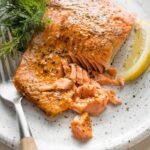
Cold Oven Salmon
The secret to perfect flakes and flavor is to start with a cold oven! Season with olive oil, salt, pepper & paprika, and that's it: perfect each time.
Ingredients
- 3-4 medium-sized salmon filets
- 1-2 Tablespoons extra-virgin olive oil
- 1/2 teaspoon paprika sweet or smoked
- kosher salt and black pepper to taste
- lemon wedges and fresh herbs such as dill or parsley, optional garnish
Instructions
- Line a rimmed baking sheet with parchment paper or aluminum foil, and place salmon filets on top, skin-side down.3-4 medium-sized salmon filets
- Brush the tops lightly with olive oil, then sprinkle evenly with paprika, salt, and pepper.1-2 Tablespoons extra-virgin olive oil, 1/2 teaspoon paprika, kosher salt and black pepper
- Place the baking sheet in the cold oven. Close the door, then turn the oven on to 400°F. Set a timer for 20 minutes.
- After 20 minutes, check the salmon. If it is done, it will flake easily when pressed with a fork and have an internal temperature nearing 145°F in the thickest part. Leave it for a few minutes if needed, but remove promptly when done.
- Serve filets as desired. We like it as a main dish with a squeeze of lemon juice and sprinkle of fresh herbs (parsley and dill are my favorites). It’s also great over salads. Enjoy!lemon wedges and fresh herbs
Last step!Please leave a review and rating letting us know how you liked the recipe. This helps my small business thrive and continue providing free recipes and high-quality content for you.
Notes
- Internal Temperature of Baked Salmon: The official USDA recommendation is to cook salmon to an internal temperature of at least 145°F. Note, however, that salmon, like most all proteins, will continue to rise in temperature for several minutes after being removed from a heat source. Because of this, many cooks recommend pulling out your salmon when the internal temperature reaches 125°F to 135°F for safe yet tender filets. How to tell the internal temperature anyway? Grab an inexpensive instant read thermometer to make it easy and remove all the guesswork.
- How Else To Tell When Salmon Is Done: No thermometer? A few other ways to assess whether your salmon is cooked: most importantly, he color will change from translucent, raw red, to a more opaque pink. It will also pass the “flake test:” press gently on a filet with a fork or your finger. Fully cooked salmon will flake easily, meaning it separates along the embedded white lines, which are strips of fat.
- White Stuff on Salmon: If you see a lot of white coating rising to the top of your salmon, that substance is albumin. It is a protein that solidifies as the salmon cooks and is completely fine to eat. Seeing a lot of it, though, probably does mean that your salmon is fully cooked and should be removed from the heat source ASAP!
- Storage: Keep any leftover salmon in the refrigerator for up to 4 days. It's even delicious to eat cold straight out of the fridge, on its own or in a salad.
-
Nutrition Estimate
Calories: 213 kcal, Carbohydrates: 0.1 g, Protein: 25 g, Fat: 12 g, Saturated Fat: 2 g, Polyunsaturated Fat: 4 g, Monounsaturated Fat: 5 g, Cholesterol: 70 mg, Sodium: 56 mg, Potassium: 630 mg, Fiber: 0.1 g, Sugar: 0.03 g, Vitamin A: 174 IU, Vitamin C: 0.003 mg, Calcium: 16 mg, Iron: 1 mg