
This post contains affiliate links. Please see our disclosure policy.
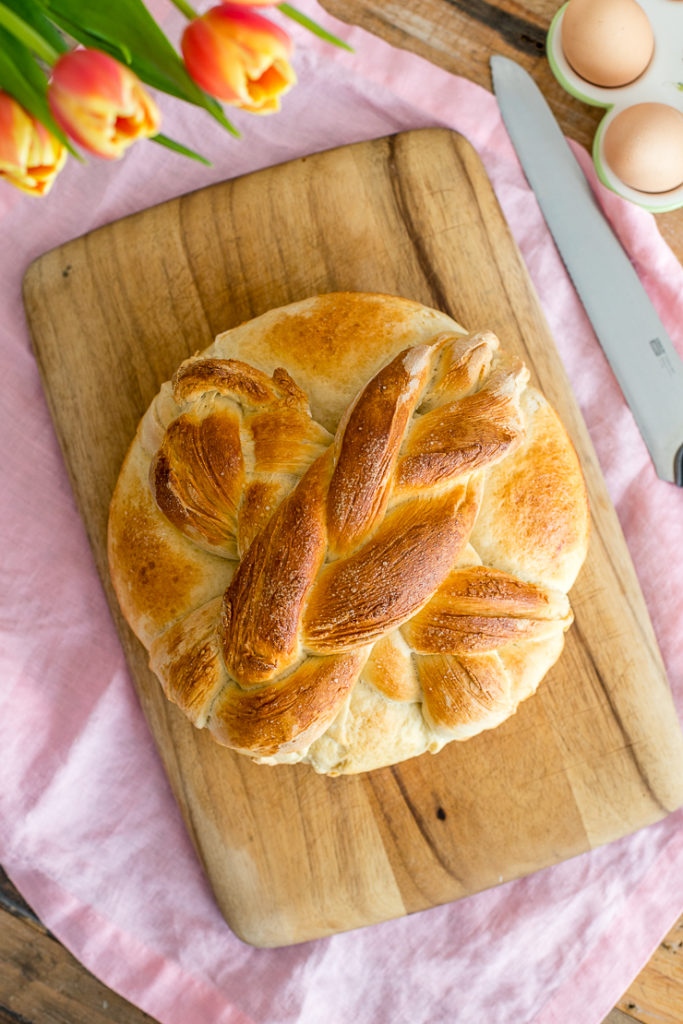
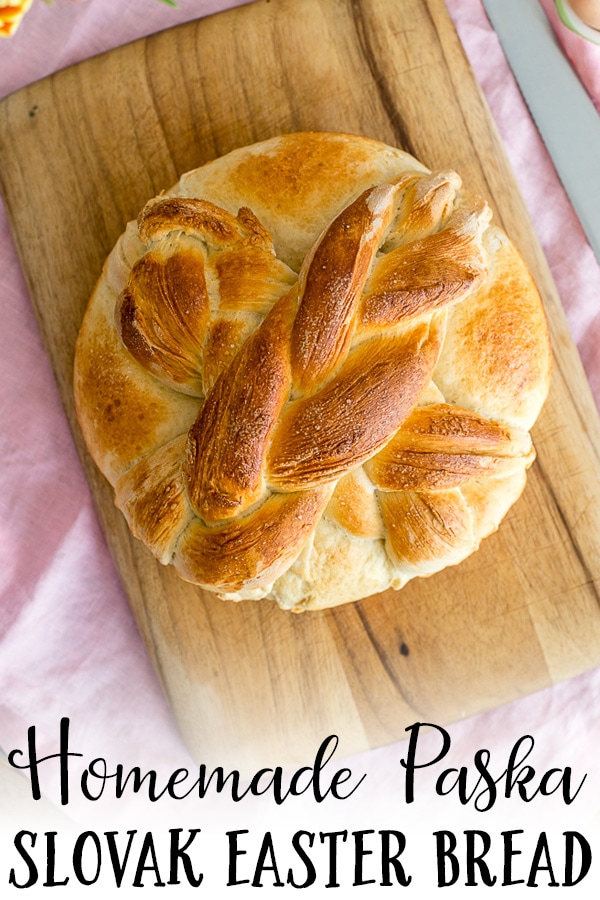
Make this rich, slightly sweet homemade paska – a traditional Slovak Easter bread, and one of my favorite childhood traditions.
And for a perfect Easter dessert, try these popular filled lemon cupcakes!
First off, let me apologize for the relative dearth of recipe activity around here recently. Random stomach bugs, sniffles, and a bout of the chicken pox knocked us flat the past couple weeks. Between the germs and random school in-service days, I’ve barely strung together two “normal” days in a row!
And now the kids are on Easter break, which in Belgium stretches for TWO FULL WEEKS. Aaaaah.
But on the plus side, that means it is Easter! And, for me, if it’s Easter, it’s time to make this amazing bread. Paska.
Traditional Slovak Easter Bread
Growing up in a family rich with Slovak traditions, I came early to love paska as a traditional yeasted Easter bread. I believe it’s also common in other eastern European traditions. I know it based on my Slovak heritage.
My Dad is 100% Slovak. (Is it possible to be 110% Slovak? Because if so I’m pretty sure he fits the bill. :)) And while my Mom is not herself Slovak, she got all of my paternal grandmother’s recipes and has been making them for years. And of the whole lot, paska is one of my absolute favorites.
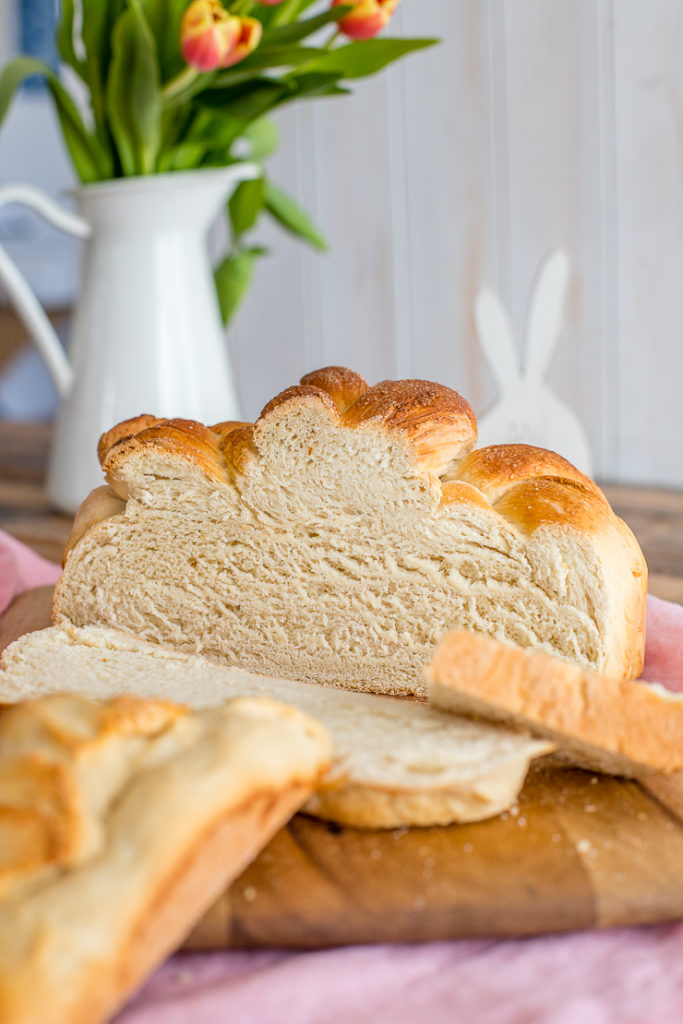
My family’s recipe for paska yields a pretty traditional yeasted bread, enriched with a bit of butter, eggs, and sugar for a sweet, brioche-like flavor perfectly suited to an Easter celebration.
For the most part, my Mom would make this as a simple round loaf. I don’t blame her one bit, especially because she was usually baking a small army of loaves. But, as I am usually making just one for our little family, the last couple of years I’ve made it with a traditional braided cross on top, and really love the special touch that it adds.
How To Make Homemade Paska
This recipe is so simple for a yeasted bread.
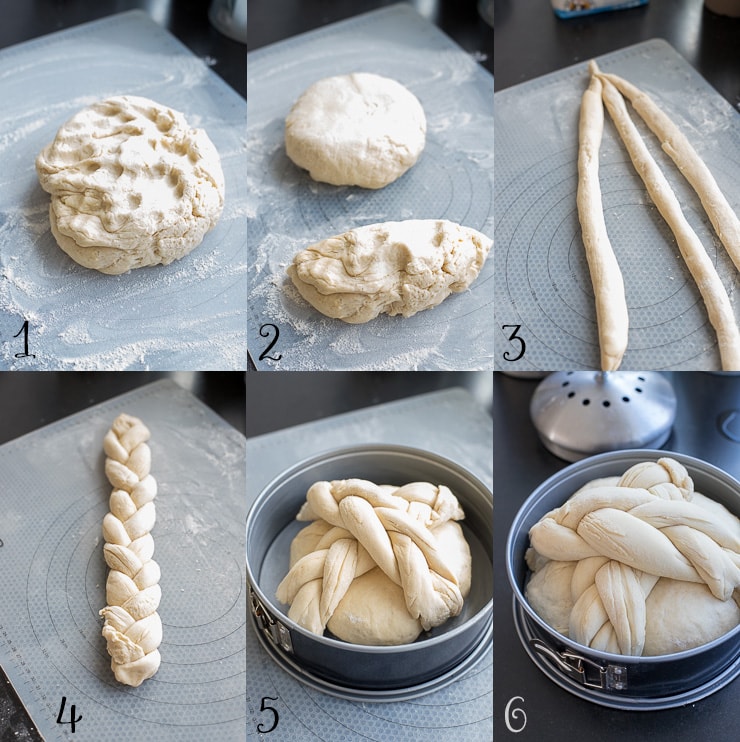
- Mix all the ingredients together, let it rise, then turn out the puffy dough onto a lightly floured work surface (photo 1 below).
- If you want to make the braid, pull off a small amount of the dough at this point (photo 2). I did about a third of it this year, and wished I had done a smaller proportion. I’ve reflected that suggested change in the recipe card below.
- Now you’ll divide that small piece of dough in thirds, and roll each one out into a long string (3).
- Braid those together (4).
- Cut in half, and lay them on top of the larger dough ball in a round baking pan (5).
- Don’t worry if there’s a lot of space around the edges–you’ll let the dough rise again, and as you can see it will fill out very nicely (6).
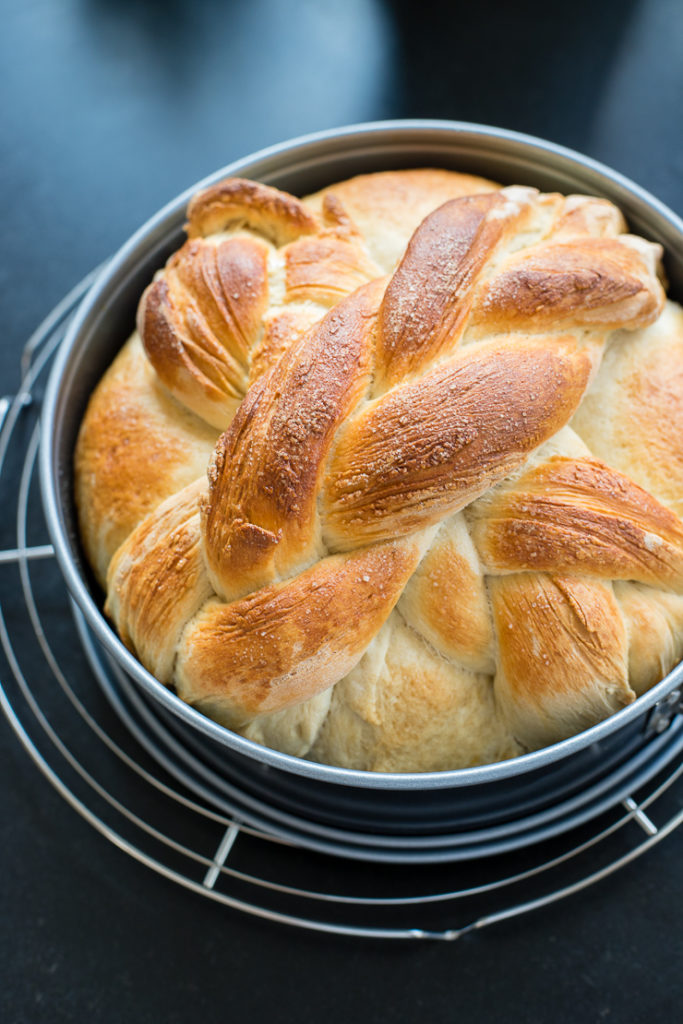
Now bake, and voila! A beautiful golden loaf is ready to go.
Let it cool completely, then remove from the pan, cut, and devour!
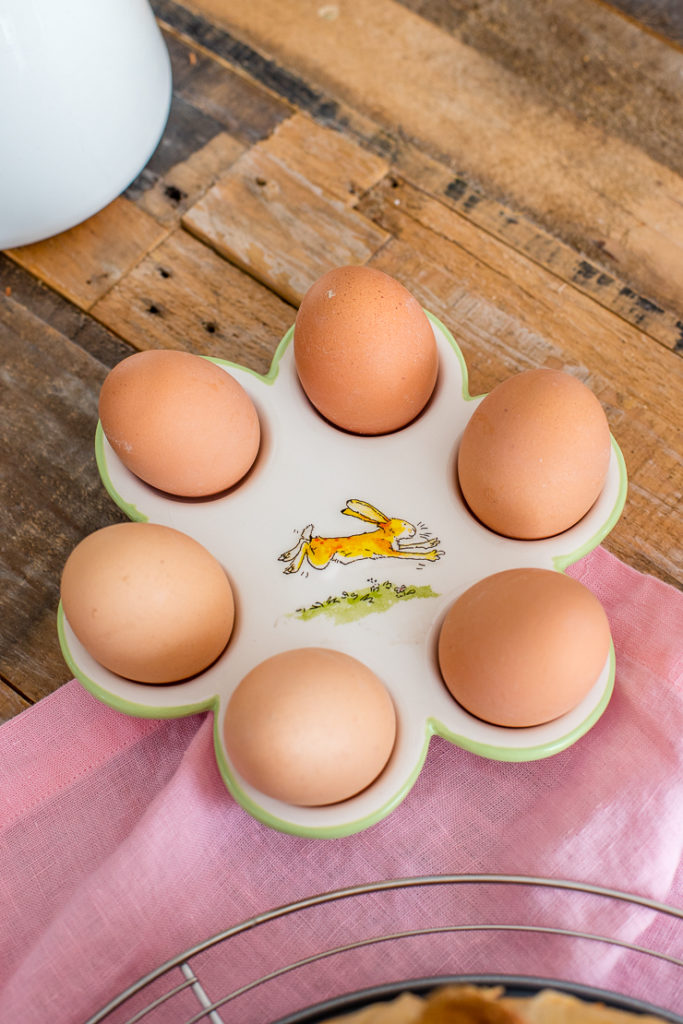
On a completely random side note, how adorable is this sweet egg holder with the bunny from Guess How Much I Love You?
We did dye eggs this year, but not until several days after I took these photos. 🙂
I’ve made this several years in a row now — and proudly texted my Mom a photo of it every time — and am really excited to be carrying this tradition forward for my own little family. Based on the fact that my almost-three-year-old was determined to eat only this bread for dinner several nights in a row, I think we’re off to a good start in the “sharing love for traditions” department!
Whether paska is a treasured childhood memory for you, or simply interests you as a new recipe, I hope you try this recipe and enjoy it as much as we do!
More Bread and Rolls:
- The Best Flour Tortillas From Scratch
- Homemade Whole Wheat Pita Bread
- Divine 1-Hour Breadsticks
- Caraway Irish Soda Bread Muffins
Homemade Paska – Slovak Easter Bread

Ingredients
Bread
- 5 cups (602 grams) all-purpose flour
- 2 1/4 teaspoons (1 packet) instant dry yeast
- 1/4 cup (50 grams) granulated sugar
- 2 1/2 teaspoons salt
- 1 cup lukewarm water
- 1/2 cup whole milk
- 2 large eggs
- 1/4 cup (4 tablespoons, 57 grams) unsalted butter, , at room temperature
Topping
- 1 large egg
- 1 tablespoon water
- 1 tablespoon granulated sugar
Instructions
- Using a stand mixer or wooden spoon, mix and knead all of the dough ingredients — flour through butter — until it comes together into a soft, smooth ball. The dough should be pliable, not very sticky, and bounce back when poked lightly with your finger.
- Place the dough in a lightly greased bowl and set aside on the counter. Allow it to rise for 60-90 minutes, until nearly doubled in size. Meanwhile, lightly grease a 9-inch round pan and set aside. (I love using a springform pan for this, but a cake pan also works well.)
- Turn the dough out onto a lightly floured work surface. Pull off about a quarter of it — you’ll use this to form the braids. Shape the remaining large piece of dough into a smooth ball, and place in the center of the prepared pan.
- Divide the reserved piece of dough into three equal pieces, and roll each one out into a strand about 18″-20″. Use these three strands to create one long braid. (See photos in post for a visual.)
- Cut the braid in half, then place in a cross on top of the larger piece of dough in the pan. (Alternatively, you could wrap the braid in one length around the inside edge of the pan.)
- Cover the loaf and let rise for about 45 minutes, until approximately doubled in size. Near the end of the rising time, preheat the oven to 350 degrees F (180 C) and place a rack in the lower-middle.
- When the bread has risen, make the topping. Beat the egg and water together with a fork in a small bowl, and brush the mixture gently over the loaf. Sprinkle with additional sugar, as desired.
- Bake bread for 35 to 45 minutes, until the top is a rich golden brown. Remove from the oven and let cool completely before cutting and serving.
Notes
- If well-wrapped, leftovers will keep for 3-4 days. Even once the bread begins to go slightly stale, it makes excellent toast if cut into thick slices, especially spread with jam. Or, for a real treat, homemade lemon curd!
- Adapted from a family recipe with a little help from King Arthur Flour, specifically to help convert a ratio of cakes to instant dry yeast.
Nutrition
Nutrition information is automatically calculated, so should only be used as an approximation.


My family would have Paska Nut bread at Easter but I can’t find it anywhere. Thinking about making this recipe but using walnuts. some recipes use raisons but not my preference. Whoul I do anything different if I wanted to use walnuts?
thanks so much
I don’t think you would need to change anything else! Let me know how it turns out!
Can you use a Bundt pan?
I have not tried it personally but don’t see why it wouldn’t work – I would grease the pan very well and watch the baking time carefully, since it obviously won’t need to bake all the way through.
I live in Western Pa and make our own paska, but the store I work at buys Italian paska with an anise flavoring from a local bakery. They do use a bundt pan or some sort of round pan for uniformity with their paska loaves. They look very nice.
Made this for the first time. It was incredibly easy , rose perfectly, but it wasn’t quite as sweet as my Babbi’s Paska bread. I’m thinking of increasing sugar to either 2/3 cup or 1/2 cup instead of just 1/4 cup. But I’ m worried if that will affect the yeast? I also warmed the milk for 15 seconds in the microwave, and I partially melted the butter. But I was so pleased the rising of the dough was successful. I also added some golden raisins.
This is a keeper!
Did you ever try it with the increased sugar amount? I also thought about increasing to 2/3 cup, but didn’t know if it would affect anything. Thanks!
I have not made the bread, YET…but I have a question…the instructions have everything dumped together into the bowl of a stand mixer…it says nothing about letting the yeast bloom first??
This was absolutely delicious! Just like my mom & granny used to make. Thanks so much for sharing!
Such a wonderful recipe! My mom used to make paska, but she’s now gone. It’s my first attempt and it turned out great! I made a braid out of the whole dough and made it into a wreath. Gorgeous. Thank you so much for making our Easter more colorful and a bit more Slovak.
Best and easiest paska recipe ever!
Yay, so happy to hear that you liked it, Wendy! Thank you for taking the time to leave this review!
I’m making this now and my dough is very sticky. Followed recipe exactly. Can I add additional flour?
Yes, definitely! Keep adding a little bit at a time until you get a tacky but not overly sticky texture.
Do you really just dump everything into the mixing bowl at once? I thought you had to activate yeast in warm water first?
I was going to try this today. I was happy to find a recipe that only makes one load, but I’m confused as to the directions.
Also, do you think I could bake this in a cast iron Dutch oven? I can’t find my round cake pan, lol!
It can depend on the type of yeast – if you have instant yeast, it’s generally OK to just mix everything together at once! But you can always combine it with the warm water first to give it a head start, and that’s especially useful if the yeast is not instant. Hope that helps! And yes you could definitely do a Dutch oven, I think that would work beautifully! Good luck and happy Easter!
Must while milk be used or can I use 1%?
I would definitely just use 1% if that’s what you have on hand!